
AcademicLabs - R&D Intelligence for Life Sciences
Atopic Dermatitis Target Landscape
Strategic Ranking & Competitive Analysis of Therapeutic Targets
An integrated analysis of 254 therapeutic targets across the atopic dermatitis research and commercial landscape, drawing on patents, publications, funded projects, and the full active biotech pipeline.
Sources analyzed
- 1,025 patents (2024–2026 priority)
- 1,188 biology publications (2025–2026)
- 585 modality publications (2025–2026)
- 272 funded research projects
- 64 active + 67 historical AD biotech programs
Executive Summary
This analysis identifies and ranks 254 distinct therapeutic targets across the atopic dermatitis (AD) research and commercial landscape. By integrating five complementary data sources - recent patents, biology and modality publications, funded research projects, and the full biotech program landscape - the resulting view distinguishes saturated targets from emerging opportunities and identifies single-sponsor monopolies on novel biology.
Strategic tiers:
| Tier | Characterisation | # Targets | Notable examples | Strategic posture |
|---|---|---|---|---|
| T1 | Saturated battlefield | 13 | IL-4/IL-13, IL-4Rα, JAK family, IL-31, TSLP, PDE4, IgE | Avoid unless differentiated modality (oral, topical, RNAi, bispecific) or geography |
| T2 | Validated next-wave | 23 | OX40, MRGPRX2, IRAK4, AhR, NLRP3, STAT6, KLK5/7, S. aureus, microbiome | M&A and partnership zone - proven biology + modality novelty |
| T3 | Emerging novel | 20 | CD200R, ILC2, PPARγ, periostin, mast cell biology, TLR2/4, FOXP3 | Whitespace - limited competition, biology-led |
| T4 | Early-signal single-sponsor | 161 | WARS1, 5-HT7, GABA-A, CCR8, CRTH2, chymase, TWEAK | High risk, breakthrough optionality - single-sponsor monopolies |
Key strategic findings:
- Type 2 inflammation axis (IL-4/IL-13/IL-4Rα + JAK family) carries 826 cross-source mentions - roughly 28% of all AD signal. Saturated, validated, modality-switch only. IL-4Rα alone has 8 active biotech programs - the most crowded single target.
- Microbiome targets (S. aureus + skin/gut microbiome + specific genera) collectively reach 318 mentions, rivaling IL-4/IL-13 (333). MatriSys Bioscience (S. hominis, Phase 1) is the regulatory template to watch. Bifidobacterium emerges as a notable validated-evidence whitespace (see balance chart below).
- The most AD-validated targets by literature evidence are IL-31RA (72/100), OX40/OX40L (71), IL-13 (71), and Bifidobacterium (62) - all scoring in the 'strong evidence' band. These should anchor any due-diligence shortlist.
- MRGPRX2 sits in an asymmetric position: 30 patents (third-deepest filing) but only one named biotech program (Deep Apple Therapeutics, preclinical) and moderate AD evidence (20/100, the lowest among heavily-patented targets). The 'industry-ahead' pattern in pure form.
- OX40/OX40L has just three named biotech programs (Inmagene Phase 2, Astraea Phase 1, Mapp Biopharm preclinical) yet carries strong AD-specific evidence (71/100). M&A-ready by every metric.
- STAT6 oral inhibitors (Recludix Pharma, DeepCure) represent the dominant alternative to IL-4Rα biologics. Both preclinical but moderate evidence (71/100) - earliest stage of the modality-switch cycle.
- IRAK4 is a textbook modality-differentiation race: three biotechs (Woomera Ph2 degrader, Polymed PROTAC, Odyssey scaffolding inhibitor) competing on different mechanisms of action against the same target. AD evidence moderate (40/100).
- Five genuine single-sponsor monopolies exist: CD200R (Ducentis), WARS1 (MirimGene), 5-HT7 (Praeventix), GABA-A (Pantherics), CCR8 (LARRK Bio). Each represents one biotech holding a novel target with minimal patent or publication trail elsewhere.
Methodology
Source data
Five AcademicLabs AI-analyzed datasets were integrated for this analysis: recent AD-relevant patents (1,025 records, filed in 2024–2026), biology publications (1,188 records, 2025–2026), modality-focused publications (585 records, 2025–2026), active funded research projects (272 records), and the full biotech landscape (423 companies analysed, yielding 64 active AD programs and 67 historical/dropped programs). Each record was AI-scored on 20–21 dimensions including target identification, novelty positioning, evidence strength, development stage, and competitive signals.
Target identification
A canonical list of 120+ AD-relevant molecular and cellular targets was defined a priori. Free-text AI answers from each source were processed with a prioritized pattern-matching pipeline that handles compound targets (e.g. IL-4 + IL-13 → 'IL-4/IL-13'; OX40 + OX40L → 'OX40/OX40L'; STING + cGAS → 'cGAS-STING'). Each target was assigned to one of 22 target classes with consistent naming applied across all five sources.
Scoring framework
Each target received four normalized (0–100) sub-scores: volume (log-scaled total cross-source mentions), novelty (first-in-class vs me-too framing across all sources), evidence (human AD-derived evidence + clinical-stage maturity), and biotech program activity (log-scaled active program count). The composite Interest Score is 0.30 × Evidence + 0.25 × Novelty + 0.25 × Programs + 0.20 × Volume.
AD evidence score - what it captures and what it doesn't
The evidence sub-score reflects the publication-level signal that a target is involved in AD specifically - measured as the share of biology publications using human AD-derived samples, combined with clinical-stage maturity flags from patents and modality publications. It captures literature-level evidence within the AD-specific corpus, not regulatory or clinical-trial validation. Clinically-validated targets whose publication record is dominated by other indications (TSLP via asthma; IL-31 via broader pruritus) score lower than their commercial maturity would suggest. The score is best read as 'how AD-specific is the evidence base?' rather than 'how validated is this target for any indication?'
Tiering
Strategic tiers were assigned using quantitative thresholds on the composite metrics, refined by expert curation. T1 (Saturated) and T2 (Validated-Hot) reflect cumulative commercial validation; T3 (Emerging-Novel) prioritizes novelty signal with thin commercial coverage; T4 (Early-Signal) captures low-volume single-sponsor targets; T5 (Meta-category) groups broad biology themes that are not molecular drug targets in themselves (Th1/Th2/Th17, Skin barrier, Multi-target, cell types as 'targets').
Column glossary - used throughout the report
Tables in this report use abbreviated column headers for compactness. The following definitions apply consistently across all tier tables, the master ranking, and the supporting pivot.
| Column | What it represents |
|---|---|
| Target | Canonical name of the molecular or cellular target (e.g., IL-4Rα, MRGPRX2, S. aureus). Compound targets such as IL-4/IL-13 represent assets engaging both ligands. |
| Class | One of 22 target classes (Cytokine, Cytokine receptor, GPCR, JAK-STAT, Kinase, Protease, Barrier protein, Microbiome, Innate immune sensor, etc.). |
| Tier | Strategic tier - T1 Saturated, T2 Validated-Hot, T3 Emerging-Novel, T4 Early-Signal, T5 Meta-category. |
| Total | Total cross-source mentions of this target across all five datasets (patents + biology pubs + modality pubs + projects + biotech programs). |
| Patents / Pat | Number of AD-relevant patents filed 2024-2026 that mention this target as a primary or secondary focus. |
| Pubs (Biology) / Pub-Bio | Number of AD biology publications (2025-2026) that mention this target - typically mechanism, target identification, or validation work. |
| Pubs (Modalities) / Pub-Mod | Number of modality-focused publications (2025-2026) covering drug-discovery work on this target - chemistry, modality development, formulation. |
| Projects / Proj | Number of currently-active funded research projects (NIH grants and equivalents) covering this target. |
| Active | Number of currently-active biotech programs targeting this in atopic dermatitis (drawn from the 64-company active landscape). |
| Hist / Historical | Number of biotech companies that previously held an AD program on this target but have since stopped, sold, or de-prioritized it. Indicator of past commercial difficulty if high. |
| Lead stage | Most advanced development stage among currently-active programs (Marketed > Phase 3 > Phase 2 > Phase 1 > IND > Preclinical). |
| Stage breakdown | Distribution of active programs across development stages, e.g., "Ph2: 1 | PC: 3" means 1 Phase 2 program and 3 preclinical programs. |
| Named programs | Specific named biotech programs targeting this, with stage and modality. Up to 6 companies shown; "PC" = preclinical. |
| Novelty (0-100) | Normalized sub-score reflecting first-in-class vs me-too framing across all sources. Higher = more novel framing in the literature. |
| Evidence (0-100) | Normalized sub-score reflecting AD-specific evidence - % of publications using human AD-derived samples + clinical-stage maturity. Strong: 60-100. Moderate: 30-60. Weak: 0-30. See Methodology note. |
| Score / Interest score | Composite Interest Score (0-100), weighted as 0.30 × Evidence + 0.25 × Novelty + 0.25 × Programs + 0.20 × Volume. |
Strategic Overview - Biology, Modality, Evidence, and Programs
The following four-dimensional view compares the 32 most-discussed AD targets across biology research depth (green), modality / drug-discovery work (purple), AD-specific evidence strength (red/amber/green band), and current biotech investment (bubble size). Targets are sorted from biology-heavy (top - research running ahead of drug development) to modality-heavy (bottom - drug development running ahead of biology). Target name color encodes strategic tier.
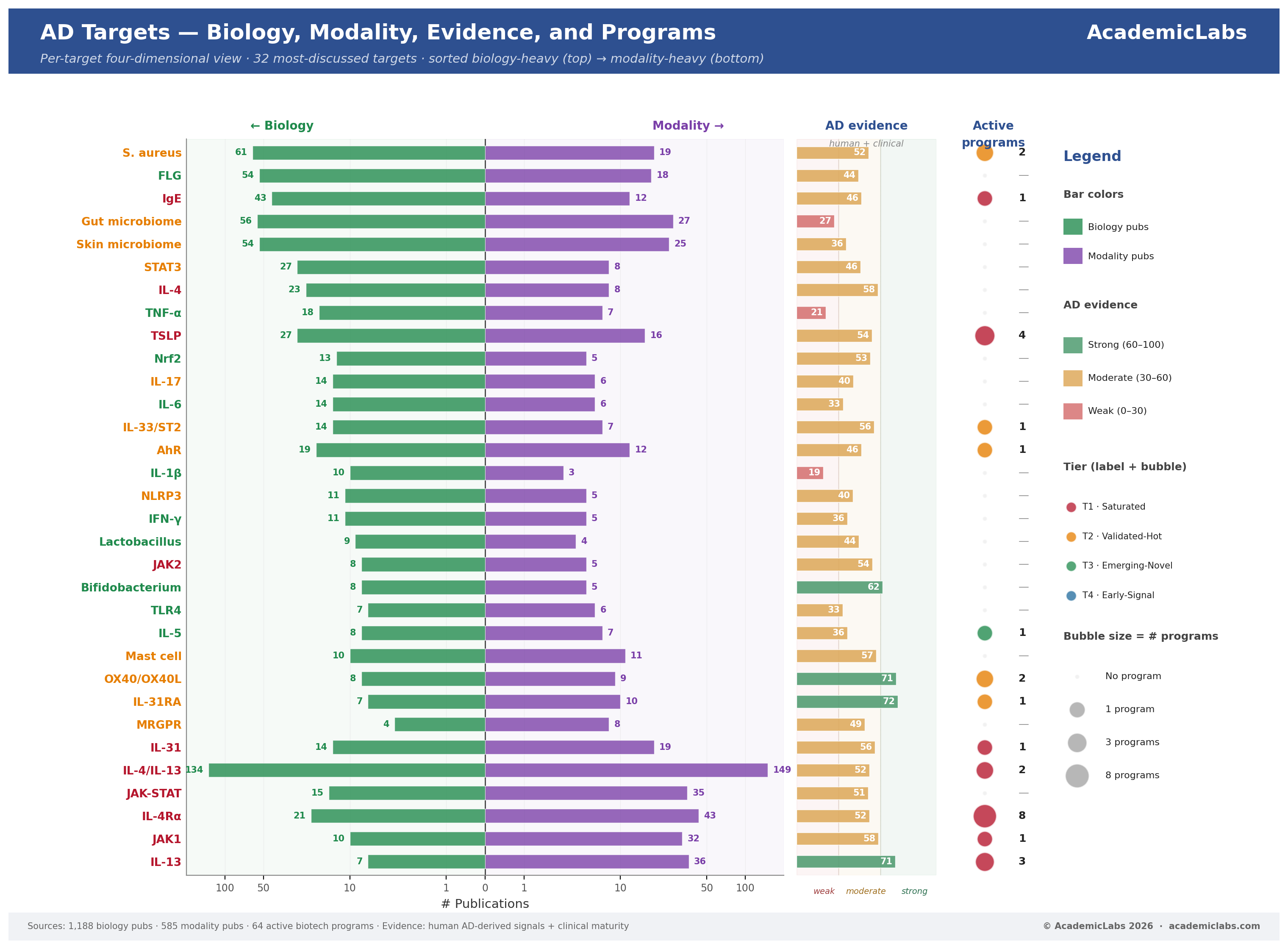
Reading the chart - patterns to look for:
- Strong evidence + biology-heavy + small or no bubble = validated whitespace. Bifidobacterium (62 evidence, biology-led, zero programs) is the single most striking example: AD-relevant biology is established but no biotech has translated. Lactobacillus (44 evidence) and other commensal microbes show similar patterns at lower evidence levels.
- Strong evidence + balanced or modality-heavy + thin biotech presence = M&A ripe. IL-31RA (72), OX40/OX40L (71), IL-13 (71) - all carry strong AD-specific evidence with 1–3 named biotechs. The highest-confidence consolidation targets in the dataset.
- Weak evidence + active programs = literature-evidence gap, not necessarily speculative. TSLP scores 21 (weak) because most TSLP biology publications reference asthma rather than AD, but the target is clinically validated (tezepelumab in AD trials). Read as 'AD-specific literature has not caught up to the commercial activity.'
- Biology-heavy + moderate evidence + no programs = pre-translational pipeline. Skin microbiome (36), Gut microbiome (27), FLG (44), IL-22 - academic interest precedes biotech entry. Watchlist for incoming founding activity.
- Modality-heavy + strong evidence + many programs = saturated commercial. IL-4Rα (52 evidence + 8 programs), JAK-STAT (51 + active programs), JAK1 (58 + 1 program), IL-13 (71 + 3 programs) - the dupilumab cluster.
Notable individual readings:
- Bifidobacterium emerges from this view as the most asymmetric whitespace target in the dataset: strong AD-specific evidence (62/100) with biology-heavy publication pattern and zero active biotech programs. Worth specific scouting attention.
- IL-4/IL-13 sits at the bottom of the chart as the saturated giant - 134 biology and 149 modality publications, 2 named bispecific programs. Moderate AD evidence (52) reflects breadth of indications beyond AD.
- S. aureus is the largest biology-heavy bubble - 61 biology pubs vs 19 modality pubs, moderate evidence (52), 2 active programs. Microbiome biology has matured commercially faster than its sister microbes.
- MRGPR (parent class) appears with 4 biology / 8 modality pubs and weak AD evidence - the modality-discovery work is the lead, not the biology validation.
Master Ranking - Top 35 Targets by Cross-Source Signal
Targets ordered by total cross-source mentions. The Interest Score column provides the composite prioritization view; Active column shows the number of named biotech programs.
Reading this table: each row is one target. Total = sum of mentions across all five datasets. Pat, Pub-Bio, Pub-Mod, Proj are per-source counts. Active = currently-running biotech programs. Score = composite Interest Score (0-100).
| Target | Class | Tier | Total | Pat | Pub-Bio | Proj | Pub-Mod | Active | Score |
|---|---|---|---|---|---|---|---|---|---|
| IL-4/IL-13 | Cytokine | T1 | 333 | 41 | 134 | 9 | 149 | 2 | 53.9 |
| Skin barrier | Pathway/process | T5 | 196 | 10 | 134 | 22 | 30 | 0 | 42.8 |
| JAK-STAT | JAK-STAT | T1 | 138 | 88 | 15 | 0 | 35 | 0 | 40.4 |
| Multi-target | Multi-target | T5 | 110 | 0 | 104 | 6 | 0 | 0 | 23.0 |
| IL-4Rα | Cytokine receptor | T1 | 108 | 39 | 21 | 5 | 43 | 8 | 62.7 |
| Keratinocyte | Stromal/epithelial cell | T5 | 107 | 4 | 49 | 18 | 36 | 0 | 54.5 |
| Skin microbiome | Microbiome | T2 | 105 | 12 | 54 | 14 | 25 | 0 | 37.3 |
| S. aureus | Microbiome | T2 | 103 | 7 | 61 | 16 | 19 | 2 | 54.8 |
| Gut microbiome | Microbiome | T2 | 96 | 5 | 56 | 8 | 27 | 0 | 37.6 |
| Th2 | Immune cell | T5 | 95 | 4 | 56 | 16 | 19 | 0 | 39.5 |
| FLG | Barrier protein | T3 | 85 | 5 | 54 | 8 | 18 | 0 | 36.5 |
| Pruritus axis | Pathway/process | T5 | 82 | 30 | 26 | 16 | 10 | 0 | 31.8 |
| Microbiome (other) | Microbiome | T5 | 80 | 12 | 51 | 12 | 5 | 0 | 29.2 |
| JAK1 | JAK-STAT | T1 | 77 | 33 | 10 | 2 | 32 | 1 | 47.3 |
| IgE | Immunoglobulin | T1 | 70 | 7 | 43 | 8 | 12 | 1 | 41.5 |
| TSLP | Cytokine | T1 | 69 | 21 | 27 | 5 | 16 | 4 | 56.4 |
| IL-13 | Cytokine | T1 | 68 | 24 | 7 | 1 | 36 | 3 | 62.9 |
| AhR | TF/Nuclear receptor | T2 | 56 | 22 | 19 | 3 | 12 | 1 | 40.9 |
| IL-31 | Cytokine | T1 | 56 | 20 | 14 | 3 | 19 | 1 | 44.8 |
| Type 2 inflammation | Pathway/process | T5 | 53 | 4 | 40 | 2 | 7 | 0 | 21.5 |
| MRGPR | GPCR | T2 | 50 | 37 | 4 | 1 | 8 | 0 | 29.5 |
| IL-33/ST2 | Cytokine receptor | T2 | 47 | 19 | 14 | 7 | 7 | 1 | 41.6 |
| IRAK4 | Kinase (non-JAK) | T2 | 43 | 39 | 2 | 0 | 2 | 3 | 43.3 |
| NLRP3 | Innate immune sensor | T2 | 42 | 25 | 11 | 1 | 5 | 0 | 27.2 |
| STAT3 | JAK-STAT | T2 | 40 | 4 | 27 | 1 | 8 | 0 | 31.9 |
| Treg | Immune cell | T5 | 40 | 10 | 12 | 10 | 8 | 1 | 33.7 |
| Cytokine receptor (general) | Cytokine receptor | T5 | 39 | 38 | 0 | 1 | 0 | 0 | 18.8 |
| Adaptive immune | Adaptive immune | T5 | 37 | 37 | 0 | 0 | 0 | 0 | 17.0 |
| MRGPRX2 | GPCR | T2 | 37 | 30 | 0 | 1 | 6 | 1 | 27.3 |
| Mast cell | Immune cell | T2 | 36 | 10 | 10 | 5 | 11 | 0 | 35.6 |
| IL-4 | Cytokine | T1 | 35 | 3 | 23 | 1 | 8 | 0 | 33.3 |
| IL-17 | Cytokine | T2 | 34 | 13 | 14 | 1 | 6 | 0 | 25.8 |
| TNF-α | Cytokine | T3 | 34 | 9 | 18 | 0 | 7 | 0 | 21.4 |
| Metabolic | Metabolic | T5 | 34 | 34 | 0 | 0 | 0 | 0 | 18.7 |
| Th17 | Immune cell | T5 | 33 | 5 | 16 | 2 | 10 | 0 | 27.2 |
Tier 1 - Saturated Battlefield
These targets define modern AD therapeutics. They are validated, clinically proven, and represent the bulk of patent activity and commercial competition. For new entrants without a modality or geographic edge, this is hostile terrain dominated by dupilumab (IL-4Rα), the JAK family (upadacitinib, abrocitinib, baricitinib), nemolizumab (IL-31), tezepelumab (TSLP) and crisaborole (PDE4).
Table columns: Total = total cross-source mentions; Patents = # patents filed 2024-2026; Active = # currently-running biotech programs; Hist = # biotechs that previously had a program on this target but have since stopped/sold; Named programs = specific companies with stage and modality.
| Target | Class | Total | Patents | Active | Hist | Named programs |
|---|---|---|---|---|---|---|
| IL-4Rα | Cytokine receptor | 108 | 39 | 8 | 0 | Sanofi (Marketed, mAb); Connect Biopharma (P2, mAb); Su Zhou Kang Nai De Sheng Wu Y (clin, mAb); Seasun (PC, topical); Suzhou Pharmavan Co (PC, small |
| TSLP | Cytokine | 69 | 21 | 4 | 1 | Proteologix (P1, bispecific); Kelun (IND, bispecific); Beike (PC, LBP); Scinai Immunotherapeutics (PC, nanobody) |
| IL-13 | Cytokine | 68 | 24 | 3 | 0 | Paragon (P2, mAb); Proteologix (P1, bispecific); MD Healthcare (PC, EV) |
| IL-4/IL-13 | Cytokine | 333 | 41 | 2 | 2 | DeepCure (PC, small mol); Scinai Immunotherapeutics (PC, nanobody) |
| JAK1 | JAK-STAT | 77 | 33 | 1 | 0 | Alys (PC, siRNA) |
| PDE4 | Phosphodiesterase | 31 | 20 | 1 | 0 | Eucrisa (Marketed, small mol) |
| IgE | Immunoglobulin | 70 | 7 | 1 | 2 | epitoMAP (PC, mAb) |
| IL-31 | Cytokine | 56 | 20 | 1 | 0 | Chugai (P3, mAb) |
| IL-4 | Cytokine | 35 | 3 | 0 | 0 | |
| JAK3 | JAK-STAT | 15 | 8 | 0 | 0 | |
| JAK-STAT | JAK-STAT | 138 | 88 | 0 | 0 | |
| JAK2 | JAK-STAT | 31 | 18 | 0 | 0 | |
| TYK2 | JAK-STAT | 25 | 23 | 0 | 0 |
Strategic implications:
- IL-4Rα: 8 active programs concentrated in China (Connect Biopharma rademikibart, Boan, Suzhou Kang Nai De Sheng Wu, Suzhou Pharmavan, Seasun). Genuine differentiation only via Seasun (peptide nucleic acid topical), Suzhou Pharmavan (small-molecule diterpenoid topical), or Sanofi/Regeneron's dupilumab moat in the West.
- JAK family (JAK1, JAK2, JAK3, TYK2): 115 combined patents but limited novel-modality biotechs. Alys Pharmaceuticals (JAK1 siRNA, preclinical) and Zhejiang Hisun (JAK1+TYK2 dual, Phase 1) are the standouts.
- IL-31 / IL-31RA: Chugai's nemolizumab (Phase 3) is the dominant program; no significant biotech follow-on identified. IL-31RA has the strongest AD evidence in the dataset (72/100).
- TSLP: bispecific innovation lane - Proteologix (acquired by J&J in 2024) leads with PX128 (TSLP/IL-13). Kelun Biotech has a TSLP-containing bispecific in IND. Note that TSLP's AD-specific evidence score is weak (21) because most TSLP literature references asthma - this is a literature-evidence gap, not a target-validation issue.
- PDE4: Pfizer's crisaborole marketed; minimal follower biotech activity. Limited differentiation runway.
- IgE: one active novel biotech program identified (epitoMAP, IgE+ B-cell elimination), plus omalizumab repositioning interest.
Tier 2 - Validated Next-Wave (M&A and Partnership Zone)
These targets carry meaningful clinical or strong preclinical validation but limited commercial convergence. Most are single- or dual-sponsor zones with named biotechs already in or near clinic. This is where Big Pharma BD activity concentrates.
Table columns: Active = # currently-running biotech programs; Lead stage = highest development stage among them (Marketed → Phase 3 → Phase 2 → Phase 1 → Preclinical); Score = composite Interest Score (0-100); Stage breakdown = distribution e.g. 'Ph2:1 | PC:3' means 1 Phase 2 + 3 preclinical; Named programs = companies with stage and modality (PC = preclinical, P1/P2/P3 = phases).
| Target | Class | Active | Lead stage | Score | Stage breakdown | Named programs |
|---|---|---|---|---|---|---|
| S. aureus | Microbiome | 2 | Preclinical | 54.8 | Preclinical: 2 | Beike (PC, LBP); Pharmaceutical (PC, LBP) |
| OX40/OX40L | Costim/checkpoint | 2 | Phase 2 | 49.1 | Ph2: 1 | Ph1: 1 | Inmagene Biopharmaceuticals Co (P2, mAb); Astraea (P1, mAb) |
| OX40 | Costim/checkpoint | 1 | Preclinical | 48.4 | Preclinical: 1 | Mapp Biopharmaceutical (PC, mAb) |
| IL-31RA | Cytokine receptor | 1 | Phase 3 | 46.0 | Ph3: 1 | Chugai (P3, mAb) |
| S. hominis | Microbiome | 1 | Phase 1 | 44.1 | Ph1: 1 | MatriSys (P1, LBP) |
| STAT6 | JAK-STAT | 2 | Preclinical | 43.7 | Preclinical: 2 | Recludix (PC, small mol); DeepCure (PC, small mol) |
| IRAK4 | Kinase (non-JAK) | 3 | Phase 2 | 43.3 | Ph2: 1 | Preclinical: 2 | Woomera (P2, degrader/PROTAC); Polymed Biopharmaceuticals (PC, degrader/PROTAC); Odyssey (PC, small mol) |
| IL-33/ST2 | Cytokine receptor | 1 | Preclinical | 41.6 | Preclinical: 1 | Beike (PC, LBP) |
| AhR | TF/Nuclear receptor | 1 | Preclinical | 40.9 | Preclinical: 1 | Noa (PC, small mol) |
| Gut microbiome | Microbiome | 0 | 37.6 | |||
| Skin microbiome | Microbiome | 0 | 37.3 | |||
| Mast cell | Immune cell | 0 | 35.6 | |||
| IL-22 | Cytokine | 0 | 32.8 | |||
| BTK | Kinase (non-JAK) | 0 | 31.9 | |||
| STAT3 | JAK-STAT | 0 | 31.9 | |||
| MRGPR | GPCR | 0 | 29.5 | |||
| STAT5 | JAK-STAT | 0 | 28.7 | |||
| MRGPRX2 | GPCR | 1 | Preclinical | 27.3 | Preclinical: 1 | Deep Apple (PC, small mol) |
| NLRP3 | Innate immune sensor | 0 | 27.2 | |||
| IL-17 | Cytokine | 0 | 25.8 | |||
| KLK5/7 | Protease | 1 | Phase 2 | 23.2 | Ph2: 1 | Resvita Bio (P2, cell tx) |
| KLK5 | Protease | 0 | 13.1 | |||
| OX40L | Costim/checkpoint | 0 | 11.2 | |||
| KLK7 | Protease | 0 | 2.5 |
Notable T2 dynamics:
- OX40/OX40L (3 active biotechs, strong AD evidence 71/100): Inmagene Biopharmaceuticals (Phase 2, non-depleting mAb), Astraea Therapeutics (Phase 1, mAb), Mapp Biopharm (preclinical, Fc-bioengineered). Big Pharma rocatinlimab (Amgen/Kyowa Kirin) and amlitelimab (Sanofi) are already late-stage. The strongest combination of evidence + thin biotech presence in the dataset.
- MRGPRX2 (30 patents, 1 active biotech, weak AD evidence 20/100): the deepest patent activity among T2 targets, but only Deep Apple Therapeutics (preclinical) named. The lowest evidence score among heavily-patented targets - corporate IP is running ahead of literature-level AD validation. Either Deep Apple becomes the consolidation target or fast-followers enter against thin competition.
- IRAK4 (3 active, moderate AD evidence 40/100): textbook modality-differentiation race. Woomera Therapeutics (Phase 2, heterobifunctional degrader), Polymed Biopharma (preclinical, PROTAC), Odyssey Therapeutics (preclinical, scaffolding inhibitor). AD as halo indication alongside HS and RA.
- AhR (1 active, moderate AD evidence 46/100): Noa Therapeutics (preclinical, biased modulator). Tapinarof (psoriasis approved) validates the target class.
- STAT6 (2 active, strong AD evidence 71/100): Recludix Pharma and DeepCure - preclinical but represent the dominant modality-switch alternative to IL-4Rα biologics with strong literature backing.
- NLRP3 (25 patents, no active AD biotech, moderate evidence 40/100): pure industrial interest in inflammasome class, possibly repurposed from gout/atherosclerosis programs. Industry-ahead pattern without biotech follow-on.
- S. aureus + S. hominis (3 active combined, moderate to strong evidence): MatriSys Bioscience (Phase 1, S. hominis topical, strongest evidence in microbiome cluster at 94/100), Beike Biotechnology, Pharmaceutical Biotechnology - engineered probiotic and endolysin space.
- KLK5/7 (1 active, weak evidence 23/100): Resvita Bio (Phase 2, engineered probiotic delivering LEKTI-like protease inhibitors). Single named program with Phase 2 advancement against thin literature base - industry-ahead pattern.
- Mast cell biology (moderate evidence 57/100): Invea Therapeutics (Phase 2, oral chymase inhibitor) leads as the specific drug-target program. Biology supports adjacency to MRGPRX2, tryptase, and IgE programs.
- BTK (1 active, weak evidence 25/100): heavy patent activity from non-AD indications (CSU, RA) with limited AD-specific commercial focus.
- Microbiome broader cluster (Bifidobacterium 62/100 strong, Lactobacillus 44/100 moderate, both with 0 named programs): the validated whitespace zone - academic evidence for specific genera exists but commercial translation lags. Approximately 10 active programs across MD Healthcare, Beike, 4D Pharma, Derm-Biome, Pharmaceutical Biotechnology, MedMep, Rion, ExoCoBio target the broader microbiome rather than specific genera.
Tier 3 - Emerging Novel (Whitespace Zone)
Strong publication and grant novelty framing with limited commercial activity. Most targets here have zero to one named biotech programs. This is the whitespace where biology-led scouting outperforms commercial-database screening.
Table columns: Total = total cross-source mentions; Pub-Bio = # biology publications; Active = # active biotech programs; Novelty = novelty sub-score (0-100); Named programs = companies with stage. Top 30 of 20 Tier 3 targets shown (sorted by composite Interest Score).
| Target | Class | Total | Pub-Bio | Active | Novelty | Named programs |
|---|---|---|---|---|---|---|
| FLG | Barrier protein | 85 | 54 | 0 | 34 | |
| TLR2 | Innate immune sensor | 11 | 4 | 1 | 8 | Seasun (PC, topical) |
| IL-5 | Cytokine | 24 | 8 | 1 | 14 | MD Healthcare (PC, EV) |
| S1PR | GPCR | 14 | 4 | 0 | 14 | |
| Bifidobacterium | Microbiome | 14 | 8 | 0 | 16 | |
| Nrf2 | TF/Nuclear receptor | 26 | 13 | 0 | 15 | |
| IL-18 | Cytokine | 17 | 6 | 0 | 10 | |
| JAK1/TYK2 | JAK-STAT | 23 | 0 | 1 | 14 | Zhejiang Hisun Pharmaceutical (P1, small mol) |
| Lactobacillus | Microbiome | 14 | 9 | 0 | 13 | |
| PPARγ | TF/Nuclear receptor | 12 | 4 | 0 | 22 | |
| IL-6 | Cytokine | 31 | 14 | 0 | 14 | |
| TRPV1 | Ion channel | 11 | 5 | 0 | 16 | |
| IL-2 | Cytokine | 16 | 4 | 0 | 13 | |
| IFN-γ | Cytokine | 20 | 11 | 0 | 13 | |
| PI3K | Kinase (non-JAK) | 16 | 7 | 0 | 16 | |
| TLR4 | Innate immune sensor | 13 | 7 | 0 | 19 | |
| TNF-α | Cytokine | 34 | 18 | 0 | 16 | |
| IL-1β | Cytokine | 15 | 10 | 0 | 17 | |
| GPCR | GPCR | 11 | 0 | 0 | 7 | |
| Ceramide | Lipid mediator | 13 | 10 | 0 | 12 |
Selected highlights:
- Mast cell biology (moderate evidence 57/100): reframing of AD pathogenesis around mast-cell-driven inflammation connects to MRGPRX2, chymase, tryptase, and IgE programs.
- Periostin (POSTN, weak evidence 23/100): strong publication signal, minimal patent or commercial activity - likely stratification biomarker rather than direct drug target.
- ILC2: innate lymphoid cell biology in AD with adjacency to TSLP/IL-33 axis. No dedicated biotech programs identified.
- TLR2 / TLR4 (moderate evidence 40-50): bridges innate immunity and microbiome biology. 8–10 patents each with strong evidence framing but no named active biotech programs.
- PPARγ: topical PPARγ modulators emerging in dermatology context. Low overall volume but interesting class.
- FOXP3 / Treg: regulatory T-cell axis with cell therapy plays (TeraImmune for Treg, Kangstem for MSC). Translational uncertainty remains.
- STING / cGAS: thin AD-specific commercial activity; biology potentially repositioning from oncology and autoinflammation.
- Filaggrin (FLG, moderate evidence 44/100): classic genetic risk factor with strong biology-heavy publication signal. Difficult to drug directly but valuable for patient stratification.
Tier 4 - Early-Signal Single-Sponsor Targets
Low total volume (≤10 mentions) but specific named targets. Several represent single-sponsor monopolies on novel biology - high scientific risk, breakthrough optionality, and clear consolidation targets if biology proves out.
Filtered to Tier 4 targets with at least one active biotech program. Total = total cross-source mentions; Patents = # patents 2024-2026; Active = # active biotech programs; Named programs = specific companies with stage and modality.
| Target | Class | Total | Patents | Active | Named programs |
|---|---|---|---|---|---|
| CCR4 | GPCR | 5 | 3 | 1 | APT (P1, small mol) |
| Chymase | Protease | 1 | 1 | 1 | Invea (P2, small mol) |
| CD200R | Costim/checkpoint | 6 | 5 | 1 | Ducentis BioTherapeutics (PC) |
| CCR8 | GPCR | 3 | 0 | 1 | LARRK Bio (PC) |
| CCR7 | GPCR | 3 | 2 | 1 | Micar Innovation (Micar21) (PC, small mol) |
| IFN-α | Cytokine | 1 | 0 | 1 | ILC (PC, peptide) |
| CRTH2 | GPCR | 1 | 0 | 1 | Atopix (P2, small mol) |
| GABA-A | Ion channel | 6 | 4 | 1 | Pantherics (PC, small mol) |
Single-sponsor monopolies:
- CD200R - Ducentis BioTherapeutics (CD200-Fc agonist, preclinical)
- WARS1 - MirimGene (anti-WARS1 monoclonal antibody)
- 5-HT7 - Praeventix (topical antipruritic)
- GABA-A - Pantherics (peripheral allosteric modulator)
- CCR8 - LARRK Bio (Treg-depleting biologic, preclinical)
- CCR4 - APT Therapeutics (Phase 1, oral antagonist)
- CRTH2/DP2 - Atopix Therapeutics (Phase 2, historical class with prior failures)
- IFN-α - ILC Therapeutics (engineered IFN-α14)
- Chymase - Invea Therapeutics (Phase 2, oral, also relevant to Tier 2 mast cell biology)
Historical vs Active Programs
Targets where multiple companies have previously held programs but have since exited indicate either a saturated late-development cycle or repeated commercial difficulty. Worth examining for context before entering.
Filtered to targets with at least 2 historical (dropped or sold) programs. Active now = currently-running biotechs; Historical = biotechs that previously held an AD program but no longer do; Currently active companies = list of those still running.
| Target | Class | Active now | Historical | Currently active companies |
|---|---|---|---|---|
| TRPA1 | Ion channel | 0 | 4 | |
| IL-4/IL-13 | Cytokine | 2 | 2 | DeepCure (PC, small mol); Scinai Immunotherapeutics (PC, nanobody) |
| FLG | Barrier protein | 0 | 2 | |
| IgE | Immunoglobulin | 1 | 2 | epitoMAP (PC, mAb) |
| PAR-2 | GPCR | 0 | 2 | |
| TNF-α | Cytokine | 0 | 2 | |
| CRTH2 | GPCR | 1 | 2 | Atopix (P2, small mol) |
MSC (mesenchymal stem cell) approaches and CRTH2 each show 'multiple-entries-and-exits' patterns - MSC has a long history of clinical-stage AD programs without commercial breakthrough; CRTH2 has accumulated multiple Phase 2 failures across years (Atopix is the remaining persistent holdout). Historical program counts at IL-4/IL-13 and NF-κB reflect normal portfolio rotation as some programs were discontinued in favor of newer type-2 modalities.
Activity Pattern Analysis
Combining the three primary signal sources (patents = corporate intent, publications = academic biology, biotech programs = clinical translation, plus funded projects as a leading indicator) reveals distinct activity patterns. The two scatter charts below visualize the most important pairwise comparisons: where corporate IP and biotech execution align or diverge, and where funded research leads or lags commercial activity.
Corporate intent vs Biotech execution
The first scatter compares patent filing depth (Y-axis) with active biotech programs (X-axis). Each bubble is a target, colored by strategic tier, sized by total cross-source mentions. Four strategic zones emerge:
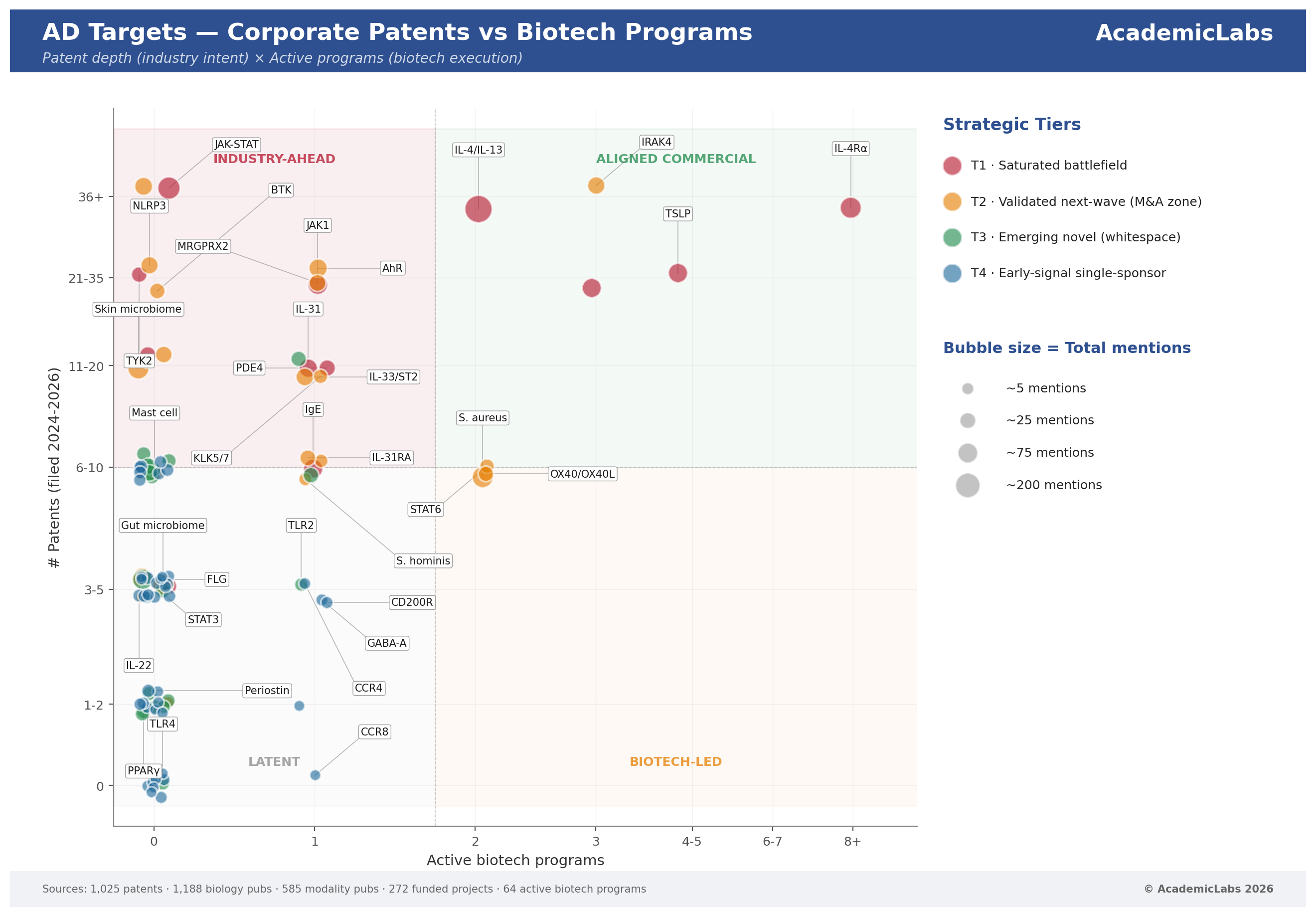
Figure 2 - Patents filed (2024-2026) × Active biotech programs.
How to read: each bubble is one target. Position on X-axis = number of active biotech programs (more programs to the right). Position on Y-axis = patent depth (more patents higher up). Bubble color = strategic tier (T1 red, T2 orange, T3 green, T4 blue). Bubble size = total cross-source mentions. Dotted lines split the chart into four strategic zones described below.
Zone interpretations:
- Industry-ahead (top-left) - corporate patents without biotech execution: JAK-STAT, NLRP3, BTK, MRGPRX2, AhR, TYK2. The M&A consolidation zone. Big Pharma is filing defensively or preparing future programs that biotechs haven't yet been founded to execute.
- Aligned commercial (top-right) - patents and programs in lockstep: IL-4/IL-13, IRAK4, IL-4Rα, TSLP. Both ends of the value chain are present. Saturated and mature.
- Biotech-led (bottom-right) - biotechs ahead of corporate filing: CD200R, S. hominis. Rare and unusual; typically indicates a biotech operating in stealth or a novel mechanism that Big Pharma has not yet patented adjacent space for.
- Latent (bottom-left) - neither corporate nor biotech yet: TWEAK, ILC2, 5-HT7, GABA-A, Periostin, IL-22, TLR4, PPARγ. Pre-translation watchlist.
Funded research vs Commercial translation
The second scatter compares funded research projects (Y-axis, a leading indicator running 3-5 years ahead of biotech formation) with active biotech programs (X-axis). This reveals where the next wave of biotechs is likely to emerge from versus where commercial activity is outpacing public research momentum.
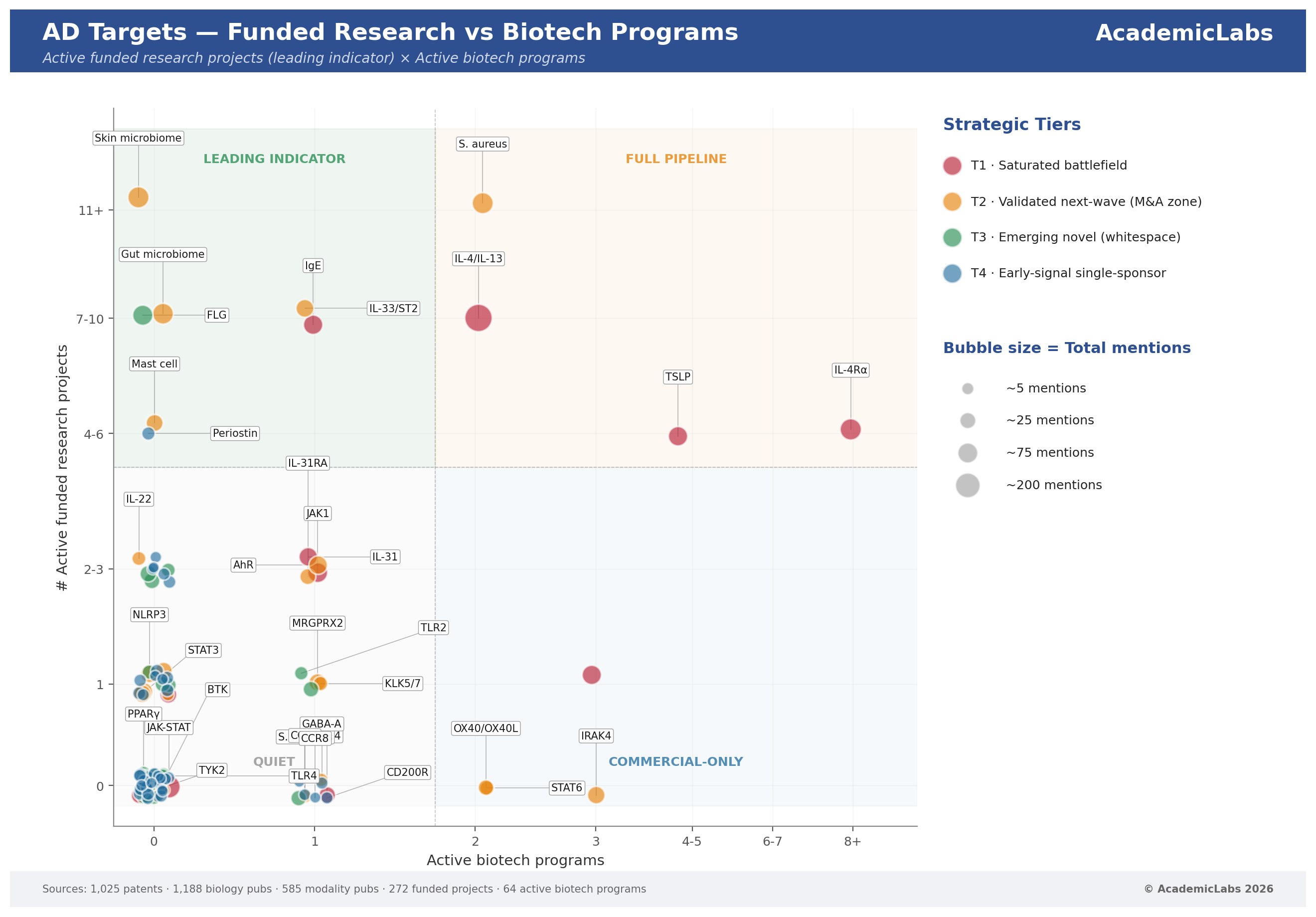
Figure 3 - Active funded research projects × Active biotech programs.
How to read: each bubble is one target. Position on X-axis = number of active biotech programs. Position on Y-axis = number of active funded research projects (NIH grants and equivalents). Bubble color = strategic tier; bubble size = total cross-source mentions. Funded research runs 3-5 years ahead of biotech formation, so the top-left zone is where tomorrow's biotechs are most likely to emerge.
Zone interpretations:
- Leading indicator (top-left) - strong public funding without biotech yet: Skin microbiome (11+ projects), Gut microbiome, FLG, IgE, IL-33/ST2, Mast cell, Periostin. These are the most likely areas to produce new biotechs in the next 3-5 years. Founding territory for biotech entrepreneurs.
- Full pipeline (top-right) - funded research and commercial programs aligned: S. aureus, IL-4/IL-13, TSLP, IL-4Rα. Most mature and well-de-risked - both academic and commercial momentum running in parallel.
- Commercial-only (bottom-right) - biotechs running without active grant pipelines: OX40/OX40L, IRAK4, STAT6. May indicate late-cycle field where academic funding has moved on, or commercially-driven discovery that academic NIH-style funding hasn't caught up to.
- Quiet (bottom-left) - neither funded nor commercialized: the bulk of the long tail. Early or stagnant; worth diligence before entry.
Reading the three views together
Combining all three visual perspectives - biology/modality/evidence balance, patents vs programs, and projects vs programs - produces sharper strategic readings than any single view. Three targets demonstrate the value of cross-validation:
MRGPRX2 - the asymmetric bet
Balance chart: low literature volume, weak AD-specific evidence (20/100). Patents × Programs: industry-ahead zone (30 patents, 1 program). Projects × Programs: quiet zone (1 project). Interpretation: corporate IP filing has run far ahead of both biotech execution and academic validation. Either a major commercial bet that hasn't yet been published, or speculative filing for a target whose biology isn't yet AD-validated. Watch Deep Apple Therapeutics closely.
Bifidobacterium - the validated whitespace
Balance chart: strong AD evidence (62/100), biology-heavy publication pattern, zero programs. Patents × Programs: latent zone. Projects × Programs: low-quiet (1 project). Interpretation: AD-relevant biology is academically established but no biotech has translated and no large patent estate exists. Founding opportunity with first-mover advantage.
OX40/OX40L - the M&A consensus
Balance chart: strong AD evidence (71/100), balanced bio/modality, 3 active programs. Patents × Programs: aligned commercial zone (clinical-stage). Projects × Programs: commercial-only zone (no grant pipeline). Interpretation: triangulated validation - strong literature, balanced patent depth, moderate biotech presence. Late-stage Big Pharma programs (rocatinlimab, amlitelimab) validate the class. The most defensible M&A consolidation target.
Strategic Synthesis
Four clusters that define the current landscape
1. The dupilumab horizon - IL-4/IL-13/IL-4Rα + JAK family
Ten active biotech programs concentrate in this cluster, the majority being Chinese me-toos plus a handful of modality-switch plays (STAT6 oral, JAK1 topical RNAi). Strong-to-moderate AD evidence across the cluster. Sanofi-Regeneron remain unchallenged in Western markets for the next ~5 years absent a true modality breakthrough.
2. The next-wave zone - OX40, IRAK4, MRGPRX2, AhR, KLK5/7
Five targets with validated or near-validated biology and single- to low-double-digit active programs. Wide range of AD evidence scores: OX40 strong (71), AhR moderate (46), IRAK4 moderate (40), KLK5/7 weak (23), MRGPRX2 weak (20). The primary BD/M&A scouting set, with evidence strength determining due-diligence priorities.
3. The pruritus / itch axis - chymase, MRGPRX2, 5-HT7, GABA-A, kappa opioid, H4R
A coherent neuro-immune cluster with multiple single-sponsor biotechs (Invea, Deep Apple, Praeventix, Pantherics) targeting different nodes. Itch-first differentiation strategy distinct from the type-2 inflammation lane, exploiting dupilumab's incomplete itch benefit.
4. The microbiome / live biotherapeutic frontier
Two analytical sub-clusters become visible from the charts: (a) named-genus biotechs targeting specific microbes - MatriSys (S. hominis, strong evidence 94/100), Resvita (KLK5/7); and (b) broader microbiome platform plays with weaker AD-specific evidence - Skin microbiome (36 evidence) and Gut microbiome (27) have 0 active programs but lead the funded-research leading-indicator zone. Bifidobacterium (62 evidence, 0 programs) is the standout validated whitespace within the cluster.
Recommendations by stakeholder
For Big Pharma BD/M&A teams:
Prioritize evidence-validated single-sponsor or low-sponsor targets. Highest priority based on combined strong AD evidence + thin commercial crowding: Inmagene Biopharmaceuticals (OX40, Phase 2, evidence 71), Recludix Pharma + DeepCure (STAT6 oral, preclinical, evidence 71), MatriSys Bioscience (S. hominis, Phase 1, evidence 94). Mid-priority due to moderate evidence: Woomera Therapeutics (IRAK4, Phase 2, evidence 40), Invea Therapeutics (chymase, Phase 2). Speculative high-asymmetry plays at weaker evidence: Deep Apple Therapeutics (MRGPRX2, preclinical, evidence 20), Resvita Bio (KLK5/7, Phase 2, evidence 23) - valuable only if the underlying biology is more advanced than the AD-specific literature captures. The Proteologix-to-J&J template (~$850M, 2024) demonstrates the precedent transaction profile.
For biotech founders and venture investors:
The leading-indicator zone of the funded-research chart identifies the highest-yield founding territory: Skin microbiome (11+ projects), Gut microbiome (7-10 projects), FLG, Mast cell biology, Periostin, IL-33/ST2. Single-sponsor 'stealth' targets - CD200R (Ducentis), WARS1 (MirimGene), 5-HT7 (Praeventix), GABA-A (Pantherics), CCR8 (LARRK Bio) - represent monopolistic positions on novel biology with high upside if validated, though most carry weak AD-specific literature evidence. Bifidobacterium stands out as the validated-whitespace founding opportunity (strong evidence 62, zero programs). Avoid IL-4Rα/IL-13/JAK unless modality wedge is genuinely differentiated.
For CRO/CDMO commercial teams:
The 64 currently-active AD biotechs represent the most immediately addressable customer set. Segment by modality for outreach: mAb-focused services to OX40 and IL-4Rα follower companies; small-molecule discovery services to the STAT6, IRAK4, and MRGPRX2 cluster; LBP and probiotic manufacturing to the microbiome cluster (MatriSys, Resvita, Beike, MD Healthcare, Pharmaceutical Biotechnology, 4D Pharma); cell and exosome services to the regenerative cluster (ExoCoBio, Kangstem, TeraImmune, Therabest, Gallant).
- End of report -